
Car Accident Claims UK: How Much Compensation Can You Get? (2025 Guide)
Last Updated: January 2025 | By James Hartwell, Legal Editor | ⏱ 9 min read
Every year, thousands of UK drivers miss out on thousands of pounds they are legally entitled to after a car accident. Whether you suffered whiplash, a back injury, or psychological trauma, you may be entitled to significant car accident compensation in the UK — even if the accident was partly your fault.
This complete guide covers everything you need to know about making a car accident claim in the UK: how much you can claim, how the process works, and how a no win no fee car accident solicitor can help you get every penny you deserve at zero upfront cost.
⚠️ Important: UK law gives you exactly 3 years from the date of your accident to file a compensation claim. Missing this deadline means losing your right to any payout — permanently.
What Is a Car Accident Claim in the UK?
A car accident claim — also called a road traffic accident claim — is a legal process that allows you to seek financial compensation from the party responsible for the accident, typically through their motor insurance provider. Under UK law, you are entitled to claim if you were injured or suffered losses due to another driver’s negligence.
Who Can Make a Car Accident Compensation Claim?
- Drivers injured in accidents caused by another motorist
- Passengers injured in any vehicle, including taxis and rideshares
- Cyclists and motorcyclists struck by a car
- Pedestrians hit by a vehicle
- Victims of hit-and-run accidents (via the Motor Insurers’ Bureau)
- Victims of uninsured drivers (also via the MIB)
Even if the accident was partly your fault, you may still be entitled to a partial payout under UK contributory negligence law. A specialist car accident solicitor can assess your exact entitlement for free.
How Much Car Accident Compensation Can You Get in the UK?
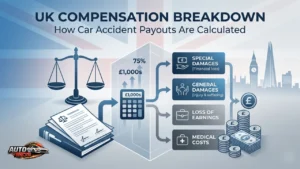
The amount of car accident compensation you receive depends on the severity of your injuries, your financial losses, and the long-term impact on your life. UK courts use the Judicial College Guidelines to calculate payouts. Below is a breakdown of typical personal injury compensation amounts for car accident claims:
| Injury Type | Severity | Compensation Range |
|---|---|---|
| Whiplash | Minor (under 3 months) | £240 – £4,215 |
| Whiplash | Moderate (3–12 months) | £4,215 – £7,890 |
| Whiplash | Severe (over 1 year) | £7,890 – £36,120 |
| Back Injury | Minor | £2,300 – £11,730 |
| Back Injury | Moderate | £11,730 – £38,780 |
| Back Injury | Severe / Permanent | £38,780 – £160,980 |
| Psychological Trauma / PTSD | Minor to Moderate | £1,540 – £19,070 |
| Psychological Trauma / PTSD | Severe | £19,070 – £52,490 |
| Head / Brain Injury | Minor | £2,200 – £12,770 |
| Head / Brain Injury | Severe | £150,000 – £380,000+ |
| Broken Arm | Simple Fracture | £6,190 – £19,200 |
| Knee Injury | Minor to Moderate | £14,840 – £26,190 |
| Loss of Earnings | Calculated Individually | £1,000 – £500,000+ |
Your total car accident compensation is calculated by combining general damages (pain, suffering, loss of amenity) with special damages (medical expenses, vehicle repairs, lost income, travel costs). Always keep all receipts, payslips, and medical records.
Types of Car Accident Claims in the UK
1. Whiplash Claims
Whiplash is the most common injury in UK road traffic accidents. It occurs when the neck is suddenly jolted forward and back, damaging soft tissues. Since the 2021 Whiplash Reform Programme, whiplash claims UK under £5,000 must be submitted via the Official Injury Claim (OIC) portal. More serious cases are handled through traditional legal proceedings and can be worth significantly more.
2. Personal Injury Claims
Any physical injury sustained in a car accident caused by another driver’s negligence entitles you to make a personal injury claim. This includes broken bones, spinal injuries, head trauma, internal injuries, and lacerations. A no win no fee car accident solicitor will handle the entire process on your behalf.
3. Vehicle Damage Claims
If the accident was not your fault, you are entitled to claim the full cost of repairing or replacing your vehicle. You are also entitled to a like-for-like courtesy vehicle while your car is being repaired.
4. Loss of Earnings Claims
If your injuries prevented you from working, you can claim both past and future loss of earnings. This is calculated using payslips, HMRC tax records, and expert financial assessments — and can represent a very significant portion of your total road traffic accident claim.
5. Psychological Damage Claims
Post-Traumatic Stress Disorder (PTSD), anxiety, and depression following a serious accident are fully claimable under UK law. Psychiatric assessments are used to quantify these damages. Many accident victims are unaware they can claim for psychological suffering in addition to physical injuries.
No Win No Fee Car Accident Claims: How It Works
The fear of legal costs stops thousands of UK accident victims from pursuing the car accident compensation they are legally owed. A No Win No Fee agreement (formally a Conditional Fee Agreement or CFA) eliminates all financial risk from the process.
How No Win No Fee Works:
- Your car accident solicitor agrees to take your case with zero upfront payment required
- You pay absolutely nothing if your claim is unsuccessful
- If you win, the solicitor takes a success fee — legally capped at 25% of your compensation
- The other party’s insurer typically covers the majority of your legal costs
- You keep the vast majority of your car accident compensation payout
⚠️ Warning: Avoid unregulated claims management companies (CMCs) that take large, uncapped fees. Always use a solicitor registered with the Solicitors Regulation Authority (SRA). Under UK law, no win no fee car accident solicitors must cap their success fee at 25%.
How to Make a Car Accident Claim: Step-by-Step Guide
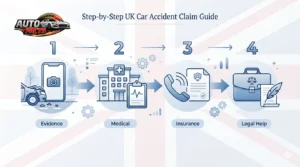
- Gather Evidence at the Scene — Photograph all vehicles, road conditions, traffic signs, and visible injuries. Collect witness names and contact details. Request a police report if one was filed.
- Seek Medical Attention Immediately — Visit A&E or your GP as soon as possible, even if you feel fine. Whiplash and soft tissue injuries often appear hours or days after impact. A medical report is critical evidence for your personal injury claim.
- Notify Your Insurance Company — Inform your insurer about the accident promptly, even if you don’t intend to claim through them. Do not admit fault at this stage.
- Contact a No Win No Fee Car Accident Solicitor — Engage a specialist road traffic accident solicitor to assess your claim at no cost. They will advise on the strength of your case and the likely compensation amount.
- Submit Your Formal Claim — Your solicitor submits the claim to the responsible party’s insurer or via the OIC portal for whiplash claims. The insurer has 15 business days to acknowledge and 40 business days to respond formally.
- Negotiate Settlement or Go to Court — Over 98% of car accident compensation claims are settled out of court. Your solicitor negotiates the maximum possible payout. If no agreement is reached, the case proceeds to a county court hearing
- How Long Does a Car Accident Claim Take in the UK?
| Claim Type | Expected Timeline |
|---|---|
| Minor whiplash via OIC portal | 1 – 3 months |
| Straightforward personal injury claim | 3 – 9 months |
| Disputed liability claim | 9 – 18 months |
| Complex or serious injury claim | 1 – 3+ years |
Common Mistakes That Can Ruin Your Car Accident Claim
Thousands of UK claimants receive reduced payouts — or nothing at all — due to easily avoidable mistakes. Make sure you do not do any of the following:
- Failing to photograph the accident scene and vehicles immediately
- Not seeking medical attention within 24 hours of the accident
- Apologising at the scene — this can be treated as an admission of fault
- Accepting the first settlement offer from the insurer (almost always far too low)
- Waiting too long — the 3-year UK limitation period is absolute and non-negotiable
- Using an unregulated claims management company instead of a proper SRA-registered solicitor
- Failing to document loss of earnings with payslips and employer correspondence
- Posting about the accident on social media — insurance companies actively monitor this

Car Accident Claim UK — Frequently Asked Questions
Can I claim car accident compensation if the accident was partly my fault?
Yes. Under UK contributory negligence law, you may still receive a reduced payout proportional to your degree of fault. If you were 30% at fault, you can still claim 70% of the total compensation amount. A specialist car accident solicitor can assess your exact entitlement during a free consultation.
What if the other driver is uninsured or fled the scene?
You can still claim road traffic accident compensation through the Motor Insurers’ Bureau (MIB) — a UK government-backed body that compensates victims of uninsured and untraced drivers. Your no win no fee solicitor can handle the MIB process entirely on your behalf.
How much does a car accident solicitor cost in the UK?
Under a no win no fee car accident agreement, you pay nothing upfront. If your claim succeeds, your solicitor receives a success fee capped at 25% of your payout by law. If unsuccessful, you pay absolutely nothing. Always verify your solicitor is registered with the Solicitors Regulation Authority (SRA).
Is there a time limit for making a car accident claim in the UK?
Yes. The Limitation Act 1980 gives you exactly 3 years from the date of your accident — or from the date you became aware of your injury — to file a claim. Exceptions apply for children (the clock starts on their 18th birthday) and those lacking mental capacity. Do not delay contacting a car accident solicitor.
Can I claim for a whiplash injury from a car accident?
Absolutely. Whiplash claims in the UK are the most common type of car accident claim. Minor whiplash injuries worth under £5,000 are submitted via the Official Injury Claim (OIC) portal since the 2021 reforms. Severe cases are handled through traditional court proceedings and can be worth up to £36,120 or significantly more.
Can I claim if I was a passenger in the car that caused the accident?
Yes. As an innocent passenger, you are almost always entitled to full personal injury compensation, regardless of which driver was at fault. You would claim against the insurance of the at-fault driver — whether that is the driver of your vehicle or the other car involved.
What is the average car accident compensation payout in the UK?
Average payouts vary widely depending on injury type. Minor whiplash claims typically settle between £1,000 and £4,000. Moderate personal injuries settle between £5,000 and £30,000. Serious or life-changing injuries involving loss of earnings, long-term care, or permanent disability can result in six or seven-figure car accident compensation awards.
Do I have to go to court to get car accident compensation?
In the vast majority of cases — over 98% — car accident claims in the UK are settled out of court through negotiation between your solicitor and the other party’s insurer. Court proceedings are only necessary when liability is strongly disputed or when the offered settlement is unreasonably low.
Key Takeaways
- You have a 3-year time limit to file a car accident compensation claim in the UK
- Compensation ranges from a few hundred pounds for minor whiplash to over £380,000 for serious brain injuries
- No win no fee car accident solicitors take your case at zero upfront cost
- You can claim even if the accident was partly your fault under contributory negligence law
- Victims of uninsured or untraced drivers can still claim via the Motor Insurers’ Bureau
- Over 98% of road traffic accident claims settle out of court
- Always use an SRA-registered solicitor — not an unregulated claims management company
Do not wait. Contact a specialist no win no fee car accident solicitor today to find out exactly how much your car accident claim is worth. The consultation is free, there is no obligation, and you have nothing to lose.
This article is intended for general informational purposes only and does not constitute legal advice. Always consult a qualified UK solicitor for advice specific to your situation.