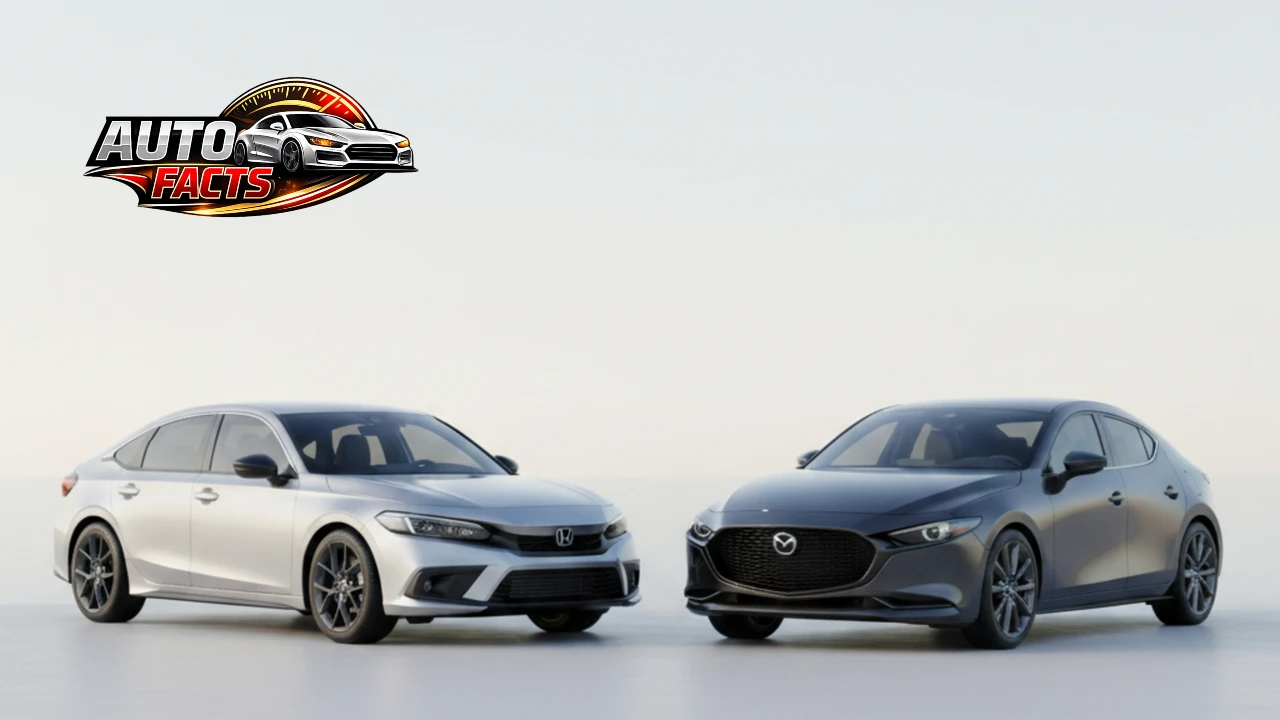
Honda Civic vs Mazda 3 | Full Comparison 2026
Choosing the right compact sedan in 2026 has become a fascinating challenge. While SUVs continue to dominate the roads, the 2026 Honda Civic and 2026 Mazda 3 prove that the small car segment is more refined, efficient, and technologically advanced than ever before. For buyers today, these two vehicles represent two very different philosophies of what a modern car should be.
In this detailed 2026 vehicle review, we break down everything from the Civic’s impressive new hybrid efficiency to the Mazda 3’s near-luxury interior and available all-wheel drive. Whether you are a daily commuter looking to save on fuel or a driving enthusiast seeking an upscale experience, this comparison will guide you toward the right choice for your lifestyle.
Overview of Each Vehicle
The 2026 Honda Civic
The Honda Civic enters 2026 following a significant mid-cycle refresh that introduced a powerhouse hybrid system across its top trims. Historically known as the benchmark for reliability and practicality, the 11th-generation Civic has evolved into a sophisticated, “mini-Accord” style sedan. It remains a top choice for those who value resale value, interior space, and a stress-free ownership experience.
The 2026 Mazda 3
The Mazda 3 has spent the last few years successfully moving upmarket. In 2026, it continues to challenge entry-level luxury brands with its “Kodo” design language and premium cabin materials. Unlike the Civic, Mazda sticks to traditional, larger-displacement engines and a conventional 6-speed automatic transmission, focusing on a tactile, “Jinba Ittai” (horse and rider as one) driving connection.
Price & Trim Comparison
Pricing for 2026 remains competitive, though both models have seen slight increases due to enhanced standard technology. Honda’s lineup is now heavily bifurcated between the affordable 2.0L gas models and the premium, high-output hybrids.
| Feature | 2026 Honda Civic | 2026 Mazda 3 |
|---|---|---|
| Starting MSRP | $24,595 (LX Sedan) | $24,550 (2.5 S Sedan) |
| Top Trim MSRP | $32,295 (Sport Touring Hybrid) | $36,740 (Turbo Premium Plus) |
| Trim Count | 5 (LX, Sport, Sport Hybrid, Touring, Si) | 6 (2.5 S, Select Sport, Preferred, Carbon, Turbo) |
| Value Proposition | Exceptional Hybrid Efficiency | Luxury Features at a Lower Entry Point |
Value Insight: While the base prices are neck-and-neck, the Mazda 3 often offers “luxury” features like leatherette seats and blind-spot monitoring at lower trim levels than the Civic. However, the Civic Hybrid’s long-term fuel savings are a major factor in its total cost of ownership.
Engine & Performance
The 2026 models offer drastically different driving personalities. Honda has pivoted toward electrification, while Mazda doubles down on internal combustion and turbocharging.
Honda Civic: Smooth Efficiency
The base 2.0L Civic produces a modest 150 hp, but the real star is the Hybrid Powertrain. With 200 hp and 232 lb-ft of torque, the Civic Hybrid is surprisingly quick, reaching 0-60 mph in roughly 6.2 seconds. It uses an e-CVT that mimics traditional gear shifts, providing a quiet and linear acceleration experience.
Mazda 3: The Driver’s Choice
The Mazda 3 comes standard with a 2.5L engine producing 191 hp—significantly more than the base Civic. For those seeking true speed, the 2.5L Turbo delivers up to 250 hp and 320 lb-ft of torque, paired with i-Activ All-Wheel Drive (AWD). It is the only car in this comparison that offers AWD, making it a favorite for buyers in snowy climates.
- Honda Civic MPG: Up to 50 City / 47 Highway (Hybrid)
- Mazda 3 MPG: 27 City / 36 Highway (Base FWD)
- Driving Feel: The Civic is light and easy to drive; the Mazda 3 feels heavy, planted, and premium.
Interior & Comfort
Inside the cabin, the two cars target different audiences. Honda maximizes utility, while Mazda maximizes ambiance.
Honda Civic Interior: The Civic’s cabin is famously airy and ergonomic. The “honeycomb” dash vent design is both stylish and functional. It offers superior rear-seat legroom (37.4 inches) and a much larger trunk in the hatchback version (24.5 cu ft vs Mazda’s 20.1 cu ft). Tech-wise, the 9-inch screen with Google Built-In on higher trims is snappy and intuitive.
Mazda 3 Interior: Mazda’s interior could easily be mistaken for an Audi or BMW. It features soft-touch materials even on lower surfaces and a minimalist layout. However, the 10.25-inch screen is controlled primarily via a rotary dial, which some users find distracting. The rear seat is notoriously tight, feeling more like a “2+2” than a true 5-passenger car.
Safety & Driver Assistance
Both vehicles are perennial IIHS Top Safety Pick winners. In 2026, both manufacturers have refined their driver-assist suites to be less intrusive and more helpful in heavy traffic.
- Honda Sensing: Includes Adaptive Cruise Control with Low-Speed Follow, Lane Keeping Assist, and Traffic Jam Assist as standard. The 2026 system is noted for its smoother braking and acceleration during highway cruising.
- Mazda i-Activsense: Offers Smart Brake Support, Blind Spot Monitoring, and Rear Cross Traffic Alert standard on most trims. Mazda’s 360-degree View Monitor on top trims is superior in clarity to Honda’s rearview camera.
Pros & Cons
2026 Honda Civic
- Pro: Incredible fuel economy (50 MPG Hybrid).
- Pro: Best-in-class resale value and reliability.
- Pro: Spacious and practical interior for families.
- Con: Road noise is higher than the Mazda 3.
- Con: No All-Wheel Drive (AWD) option.
2026 Mazda 3
- Pro: Near-luxury interior design and materials.
- Pro: Available AWD for all-weather confidence.
- Pro: Engaging steering and powerful Turbo engine.
- Con: Very cramped rear seat legroom.
- Con: Infotainment lacks a full-time touchscreen.
Real-World Considerations
When looking at reliability and maintenance, Honda typically wins on the sheer availability of parts and the simplicity of its non-hybrid engines. However, Mazda’s 6-speed automatic is often preferred by those wary of CVT transmissions. In terms of resale value, the Civic is nearly untouchable, often retaining over 60% of its value after three years.
Insurance Tip: The Mazda 3 may have slightly higher insurance premiums if you opt for the Turbo AWD model due to repair costs, whereas the Civic Hybrid might qualify for “green car” discounts depending on your provider.
Verdict / Recommendation
The Honda Civic is for you if: You want a “forever car” that is easy to park, sips fuel, and has plenty of room for friends and groceries. It is the rational, high-value choice for 2026.
The Mazda 3 is for you if: You view your car as a reflection of your style. If you rarely use the back seats and want a premium, fast, AWD-capable sedan that punches above its weight class, the Mazda 3 is the emotional winner.
Conclusion & Buyer Tips
In the 2026 Honda Civic vs Mazda 3 battle, there is no loser—only different priorities. The Civic has mastered the art of the “everything car,” especially with its new hybrid drivetrain. Meanwhile, the Mazda 3 remains the soul of the segment, offering beauty and performance that rivals luxury brands.
3 Practical Tips for 2026 Buyers:
- Test the Hybrid: If you’re looking at the Civic, don’t just drive the base LX. The Hybrid’s instant torque completely changes the driving experience.
- Check the Back Seat: If you have kids or tall friends, bring them to the Mazda dealership. The rear legroom can be a dealbreaker.
- Consider the Hatchback: Both cars offer hatchback variants. They provide much more versatility for weekend trips without sacrificing the footprint of a small car.
Ready to make a move? Check your local inventory for 2026 compact sedan deals and ensure you take both for a back-to-back test drive!